The game is available as pre-order. Shipping should start mid-July!
Qubit Race Board Game
Difficulty
Beginner
The next big leap in technology will be quantum! Over the next decade quantum technologies are expected to revolutionise our communications, healthcare, transport, financial services and above all – our computers! Qubit Race is a brand new board game from the experts at QURECA designed to help you learn about this exciting technology, all while having fun!
Qubit Race has been designed by the team at QURECA – an industry leader in providing education and training in quantum technologies. We know first hand how excited people of all ages are when learning about the world of quantum phenomena and technologies, so we decided to capture this in a board game. It’s been carefully designed to introduce core concepts – such as qubits, entanglement and quantum gates – in a fun and accessible way.
And if you’re already working in the quantum tech sector, we hope you’ll recognise some of the roadblocks and successes along the way – from funding cuts to research breakthroughs!
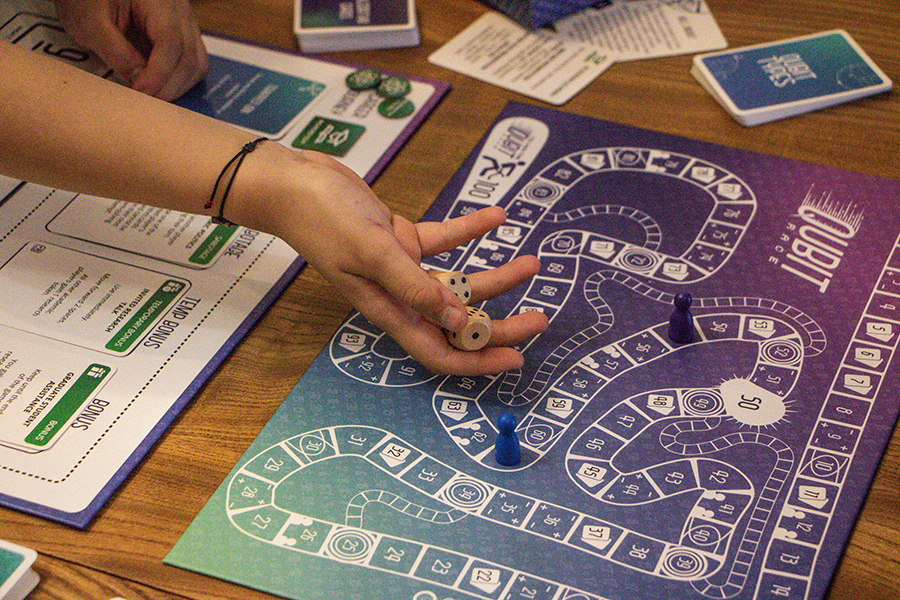
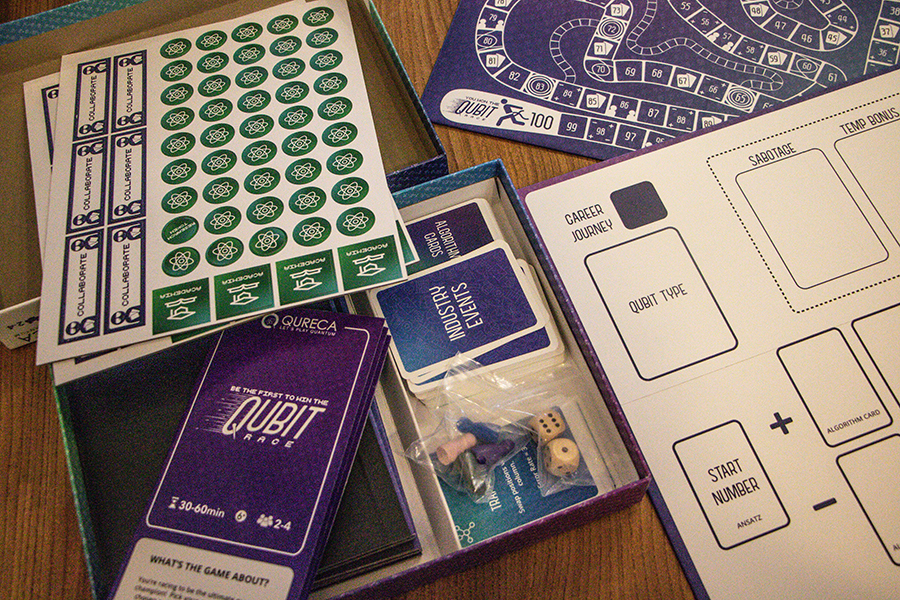
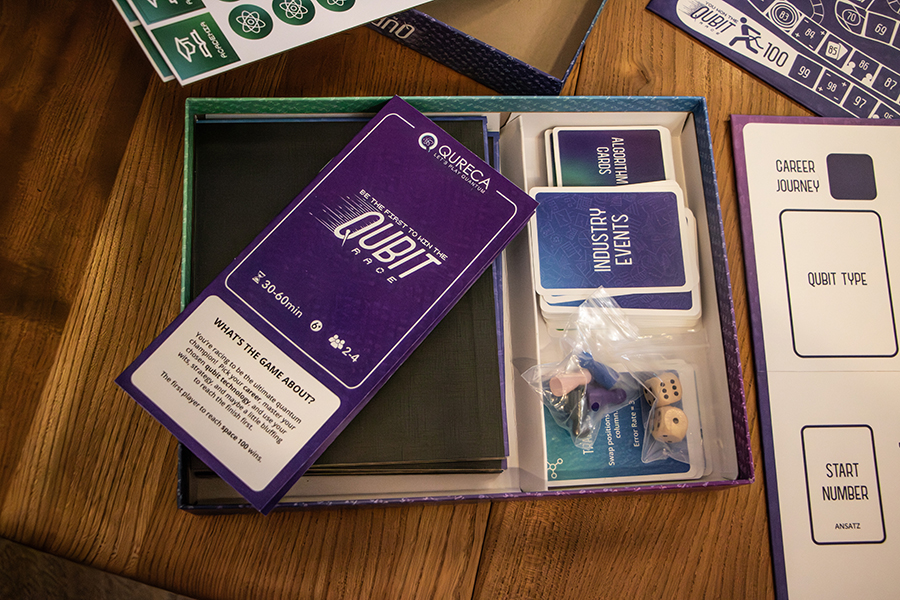
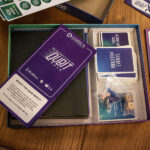
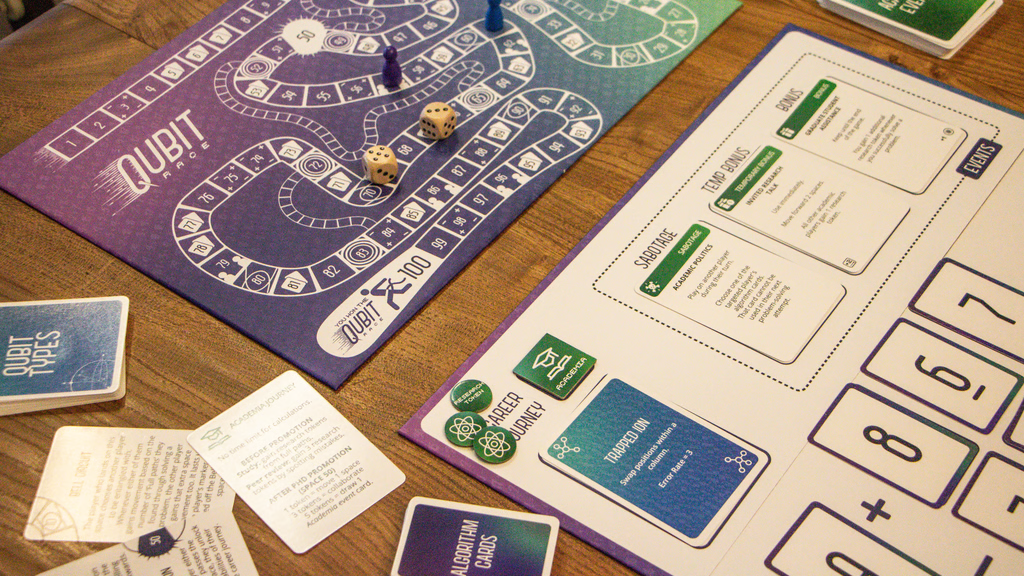
The Qubit Race board game consists of high quality components and everything you need to play. In the box you’ll find: 1x board, 4x game mats, 4x game pieces, 36x algorithm cards, 60x event cards, 40x research tokens, 4x collaborate tokens, 8x other cards, 2x dice and full instructions (with online support).





What is QUBIT RACE?
QUBIT RACE is a board and card game for ages 6 to 99 (2–4 players, 30–60 minutes) that turns the fascinating world of quantum careers into an entertaining race!
In this game, you:
🎓 Choose a career path: Academia or Industry
🔮 Select a qubit type, each with a unique ability and error rate
🧩 Solve quantum challenges using Algorithm Cards or perform Career Actions to advance
💡 Land on special spaces with surprising effects
🤝 Collaborate, bluff, and strategise your way forward
The first to reach space 100 becomes the Quantum Champion!
The aim of the game is to build a fully functional quantum computer (disclaimer: not a real one). You advance from square 1 to 100. As you race towards the goal of achieving quantum supremacy, you’ll encounter special squares inspired by real quantum computing concepts: Hadamard gates, CNOT gates, Bell circuits, quantum tunnelling. If you’re not familiar with these terms – don’t worry, they’re explained in the rules but each one has advantages and setbacks rooted in the actual physics they represent. So landing on a Bell circuit square will entangle you with another player, sharing movement bonuses between you. A quantum tunnelling space will instantly teleport you to a paired location on the board. CNOT gates and Hadamad gates are a little more technical – they affect the algorithms you must solve to progress around the board.
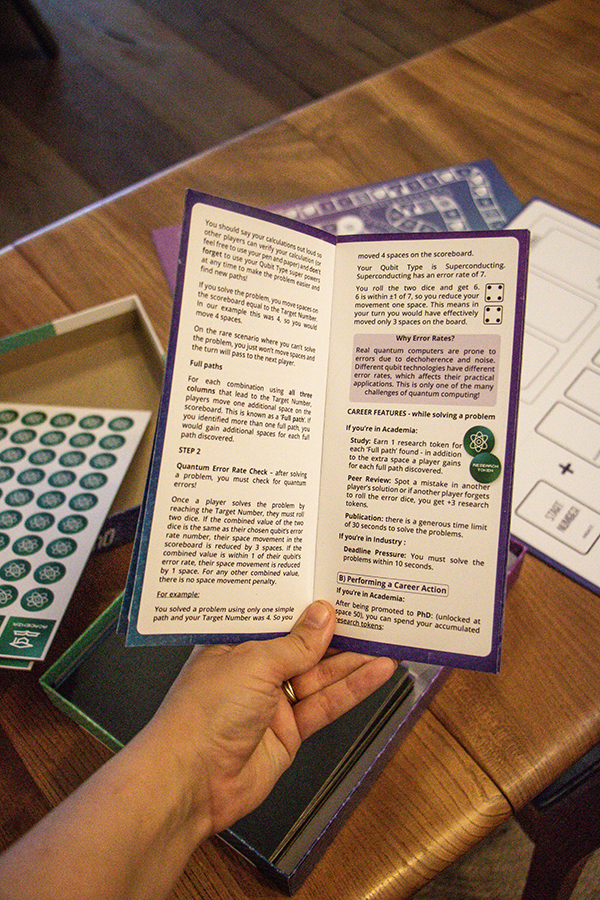
Speaking of which, unlike most games the number of spaces you move and where you land isn’t determined by the roll of a dice – instead we came up with a unique algorithm based mechanism for progressing.
Why algorithms? Quantum computers will be able to solve complex problems beyond the reach of classical computers. To do this they’ll use special sets of instructions (or ‘algorithms’) especially developed to make use of the unique properties of ‘qubits’, the building blocks of quantum information processing. In reality programming quantum algorithms can be incredibly complex – but we want the game to be fun so we’ve kept things simple!
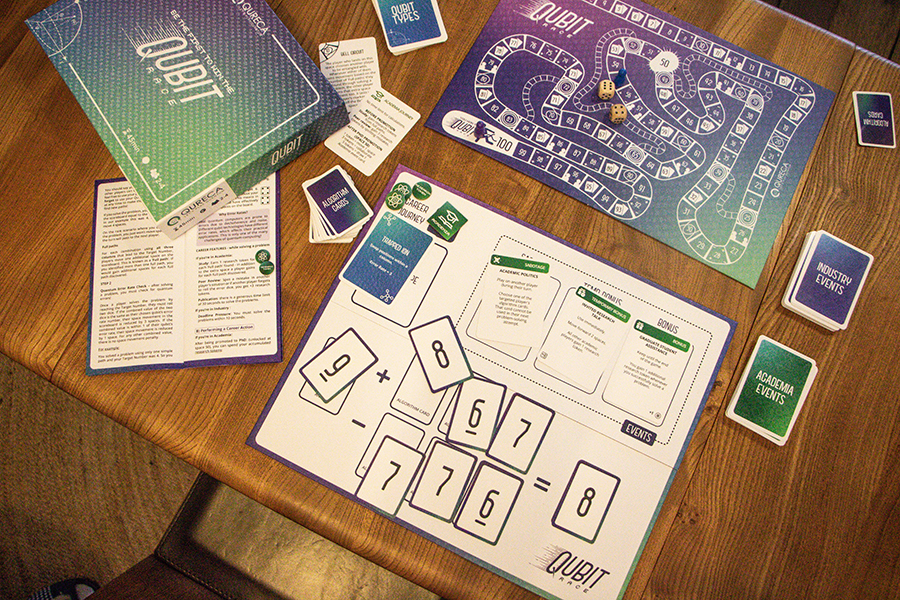
In Qubit Race the player picks one card with a number between 1 and 9. This is your start number. A second card gives you your target number. You then lay out six more ‘algorithm cards‘ in-between the start and the target. These represent the numerical operations you have at your disposal. The game playing mat includes dedicated spaces for each card to keep things clear:

The aim is to get from the starting point to the target by adding and subtracting a selection of the other numbers: this is known as a ‘path’. But like any algorithm there are some constraints. You must use at least one number. Numbers in the top row can only be added, and the numbers on the bottom row can only be subtracted. And you can’t use both the top and bottom number from any column.

Can you solve the example problem above using these rules? *See the bottom for answers!*
So where does the ‘quantum advantage’ come in? While some combinations of cards will be easy to solve, others will be impossible – no matter what order you try to add and subtract your numbers, you can’t get from the start to the target. This is where the power of quantum computing comes into play. Depending on the type of quantum computer you have at your disposal, you’re able to manipulate the numbers by swapping rows or columns, or replacing cards. This gives you more flexibility in your calculations and hopefully at least one pathway to the right answer! And if it’s still unsolvable? Then you’ve found a problem that’s beyond the reach of the quantum computer too.
The more solutions you find, the more spaces you can move around the board. And solutions which use numbers from all three columns (a ‘full path’) give you an additional movement bonus.
* Both 6 + 3 – 5 = 4 and 6 – 9 + 8 – 1 = 4 are valid answers. There may be others!
Superconducting. Trapped Ion. Silicon Spin. Neutral Atom. Photonic.
 If you’re familiar with quantum computing you’ll recognise these as the leading types of hardware that are being developed to create fully functional (and commercially useful!) quantum computers in the next few years.
Each type of hardware utilises a different type of ‘qubit’ (the building blocks of quantum computing) – such as photons of light guided on a circuit or charged atoms controlled by lasers and microwaves.
In our game we haven’t delved too deeply into the technical details but we wanted to recognise that each platform has its own advantages and disadvantages. At the start you’ll choose one of the qubit types as your preferred technology, and these will give you a special ability you can use when solving algorithms (see our previous update). Some qubit types are better suited to some problems than others – which is we what we expect from the real-world technologies too!
Whatever the hardware, all quantum computers will have to be able to overcome a major engineering barrier: ‘noise’. The qubits are incredibly sensitive to their environment, and any interactions with external influences can cause quantum information to be lost (this is why some types of hardware need to be cooled to temperatures near absolute zero and others require ultra-high vacuums to operate in). In Qubit Race, these ‘errors’ come into play after you’ve solved an algorithm. Roll the dice and depending on your chosen qubit type you may face a setback in your progress!
Quantum technologies were born in the lab. Without the insights of pioneering quantum scientists from the early 20th century onwards we wouldn’t have an understanding of the quantum phenomena that underpin quantum information processing. And without today’s research projects and multi-million pound facilities we wouldn’t be able make continual advances in our control the individual atoms or particles of light that make up the building blocks of quantum computing.
But research alone won’t be enough to bring a fully functional quantum computer to market. The role of industry is to take these innovate concepts and nurture them through investment, commercialisation and user testing until they meet a useful purpose for society and then release them into the wild (AKA the marketplace).
That’s why Qubit Race gives you the choice to play on one of two ‘tracks’ – research or industry. In the former, solving algorithms not only allows you to progress around the board, but to gain ‘research tokens’. Once you pass the halfway point (square 50) you get promoted to PhD level and can use your accumulated research tokens for a gameplay advantage. You can even spot errors in your competitors’ calculations for an additional bonus (our version of peer review!).

On the industry track, there are no tokens to collect, and you’re under tighter deadlines to solve problems. In return, you have the ability to collaborate with other players for a mutually beneficial advantage. Or you can turn against your competitors by increasing market pressure and forcing them to solve problems even more quickly if they want to progress.

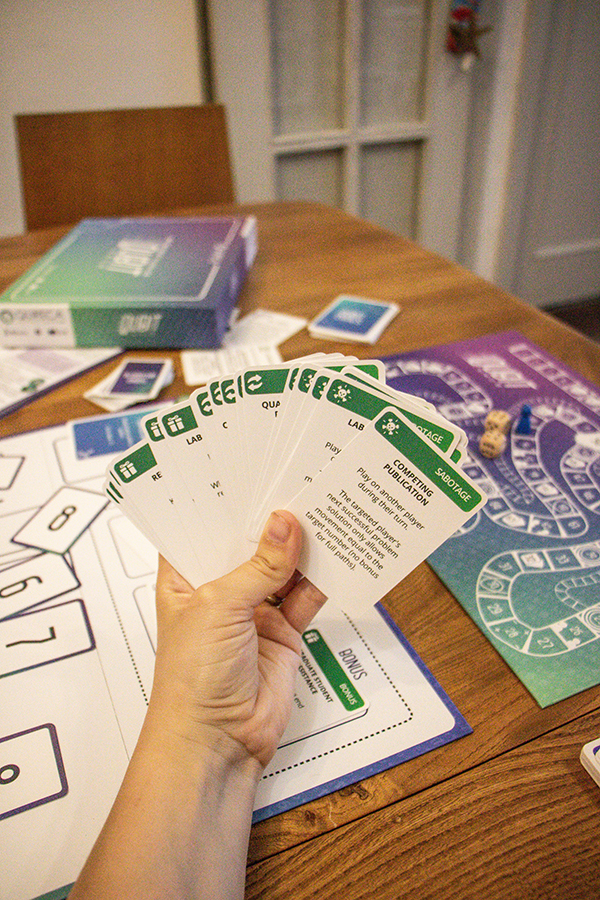
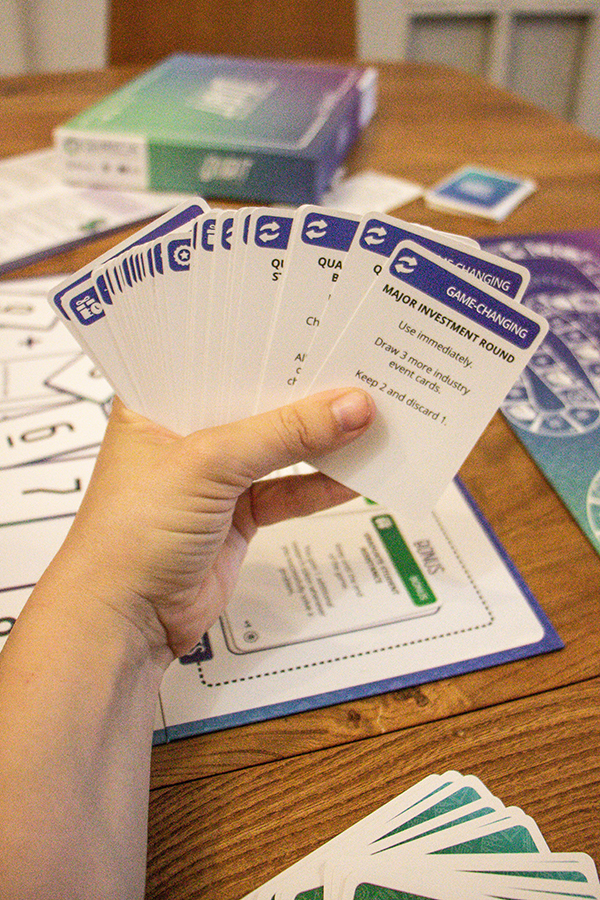
Both industry and research can throw up unexpected hurdles. These are represented by ‘event’ cards. Draw one of these as a researcher and you could find yourself having your research rejected, your grant funding cut or facing a disastrous lab failure. And in industry you might face a supply chain failure, patent infringement or a compliance issue.
But it’s not all bad news. We wanted to represent the excitement of research breakthroughs or commercial advances as well. A researcher might find themselves with an invitation to present at conference or even a demonstration of quantum advantage. And in industry you might find yourself undegoing a major investment round or launching a new software platform.
All of these events are designed to mirror the challenges and rewards of the quantum computing sector, and if you study or work in the sector some of them might sound familiar!
Preorder your game now!
40 €
More Games you might like!
Quantum enthusiasts with the same interests as you have also enjoyed these products.